Help System Search
HomeTeamsONLINE Sports Websites for Teams, Leagues & Schools
When two or more teams finish with the same record, a tiebreaker decides who is placed higher. Most leagues and tournaments write their own tiebreaker rules, and the order matters as much as the rules themselves. This page explains how tiebreakers work in general, and how to set them up on a HomeTeamsONLINE site.
| How do you break a tie in league standings? |
|
A tiebreaker is an ordered list of rules. When two teams have the same record, you apply the first rule. If that separates them, you stop. If it does not, you move to the next rule, and so on down the list.
There is no universal standard. What matters is that your league publishes its order before the season and applies it the same way every time. |
| How do you break a three-way tie in pool play? |
|
A three-way tie works differently from a two-way tie, and this is where most disputes start. You do not compare the teams in pairs. You compare all three at once, using only the games those three teams played against each other. Once one team is separated out, the remaining two revert to the normal two-team tiebreaker, starting again from the top of the list.
The common mistake is comparing team A to team B, then team B to team C, and ending up in a loop where each team beat one of the others. Comparing all three at once avoids that. |
| What does head to head mean in standings? |
|
Head to head means the result of the games the tied teams played against each other, ignoring every other game in the season. It is the most widely used first tiebreaker because it is the most direct evidence, the teams settled it on the field. It stops working when the tied teams never played, or split their games evenly, which is why it is never the only rule in the list. |
| What is point differential and how is it used as a tiebreaker? |
|
Point differential is points scored minus points allowed. A team that scored 60 and allowed 40 has a differential of plus 20. It rewards teams that won by more, so it separates teams that head to head could not. Many youth leagues cap it, counting a maximum margin per game, so that running up the score does not decide a championship. |
| Should I use points for or points against as a tiebreaker? |
|
They reward opposite things and it is worth choosing deliberately. Points against places the better defensive team higher, and it cannot be gamed by running up the score. That is why many youth and recreational leagues put it ahead of points for. Points for places the higher scoring team higher, which suits leagues where offense is the point of the format. |
| What order should tiebreakers go in? |
|
Order from the most direct evidence to the least. Head to head first, because the teams settled it themselves. Then a measure across all games, such as differential or points against. Then a broader record such as division record. Then something arbitrary such as a coin flip, as a last resort only. Publish the order before the season starts. A tiebreaker decided after the fact will always look like it was chosen to favor someone. |
| Where do I change the tiebreaker settings? |
|
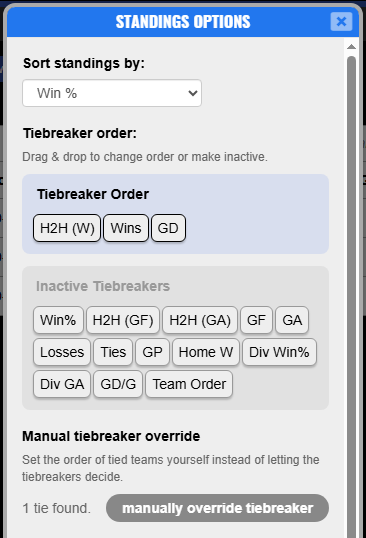
Go to your Standings page in the admin and open the options. The screen is called Standings Options and it holds three separate things that are easy to confuse:
Most people never open this screen and never realise how much of it is adjustable. If your standings are not ordering the way your league rules say they should, this is where to look first.
|
| Can I set my own tiebreaker rules? |
|
Yes. On a HomeTeamsONLINE site you build the tiebreaker order yourself by dragging, rather than picking a fixed combination from a list. The Standings Tiebreaker screen has two areas. Tiebreaker Order holds the rules that are active, top to bottom in the order they run. Inactive Tiebreakers holds the rest. Drag between the two areas to turn a rule on or off, and drag within the top area to change the order. At least one tiebreaker must stay active.
The standings recalculate as scores are entered, so the order is always current. |
| What if teams have played a different number of games? |
|
Wins alone will mislead you. A team with 8 wins from 12 games has not done better than a team with 7 wins from 8 games. Use win percentage as the primary sort instead of raw wins. It divides wins by games played, so an uneven schedule stops distorting the table. This is common in leagues where weather cancellations leave teams with different game counts. On a HomeTeamsONLINE site the options for this are Win% and the per game differential, shown as PD/G, GD/G or RD/G depending on the sport. |
| Can I set the standings order manually? |
|
Yes. Sometimes a league office rules on a tie in a way no formula captures, such as a forfeit, a disciplinary decision, or a rule specific to that season. A HomeTeamsONLINE site lets you drag teams into the order you want from the standings screen, and that manual order overrides the calculated tiebreakers for the teams you ranked. Teams you did not touch keep sorting by the configured rules as normal. There is also a Team Order tiebreaker you can place anywhere in the order if you would rather it apply as one rule among the others. |
| What happens if teams are still tied after every tiebreaker? |
|
At some point the rules run out, and every well written set of tiebreakers says what happens then. The usual answers are a coin flip, a drawn lot, or co-champions with both teams sharing the position. For a playoff spot that cannot be shared, a one game playoff is the fairest option if the calendar allows it. Whatever you choose, write it down in the rules before the season. The last line of a tiebreaker list is the one people argue about. |

Toll-free Support Hotline
(800) 486-0505
Weekdays 9:00 AM - 4:00 PM (EST)
Phone support not available on federal holidays.

Email Support
HomeTeamsONLINE continues to expand and improve its features thanks to the feedback and comments from our users. Please let us know if you have any questions or suggestions.